Care
Folding knife pivot adjustment guide
How to think about stiff action, washers, bearings, blade centering, pivot screws, lubricant, and when not to adjust a folding knife.
As an Amazon Associate I earn from qualifying purchases.
Research basis: maintained product records and referenced background material. This page does not claim hands-on testing unless it documents that work explicitly. Editorial method.
Quick answer
Do not loosen the pivot just because a folding knife feels stiff. First clean visible lint and grit, wipe tape residue from the blade, dry the pivot area, and add only a tiny amount of suitable lubricant if the action still feels dry. Smooth action is useful only when the blade stays centered, the lock seats consistently, and there is no unsafe blade play.
For DISPATCH buyers, use the 3 inch drop point liner lock pocket knife as the compact lock-and-pivot example, the 3.58 inch drop point G10 folding knife as the larger outdoor example, and the 3.54 inch 8Cr13MoV G10 folding pocket knife as the broad utility example.
| Problem | Try first | Pivot adjustment? | Stop if |
|---|---|---|---|
| Stiff opening on a new knife | Inspect, clean, and verify the listing and warranty details. | Not first. | You do not have the exact bit or the lock feel is unclear. |
| Gritty action after pocket carry | Brush lint from the handle channel and wipe the blade. | Only after cleaning fails. | Grit remains inside the pivot. |
| Blade off center | Check for debris and uneven screw tension. | Small, careful changes only. | The blade starts rubbing or develops play. |
| Blade play | Stop using the knife and inspect safely. | Maybe, but not as a casual fix. | Lockup changes or the screw starts to strip. |
Clean before you touch the pivot screw
Many rough-action problems are dirt problems. Cardboard dust, tape adhesive, pocket lint, and dried moisture can make a knife feel worse than it really is. Clean the outside first, then work the blade slowly and listen for scraping or grinding.
Use less lubricant than seems necessary. One tiny drop near the pivot, followed by slow opening and closing and a full wipe-down, is usually safer than flooding the handle. Excess oil collects grit and can make the next cleaning harder.
Washers versus bearings
Washer pivots use thin washers between the blade and handle liners. They often feel controlled and can tolerate ordinary dirt better, but they may not feel as free-swinging. Bearing pivots use small balls or bearing races. They can feel very smooth, but dirt, water, and pocket grit can matter more.
Neither system is automatically better. For a utility knife that opens packages, breaks down cardboard, and rides in a pack, predictable action and easy cleaning matter more than drop-shut feel.
Knife pivot tool checklist
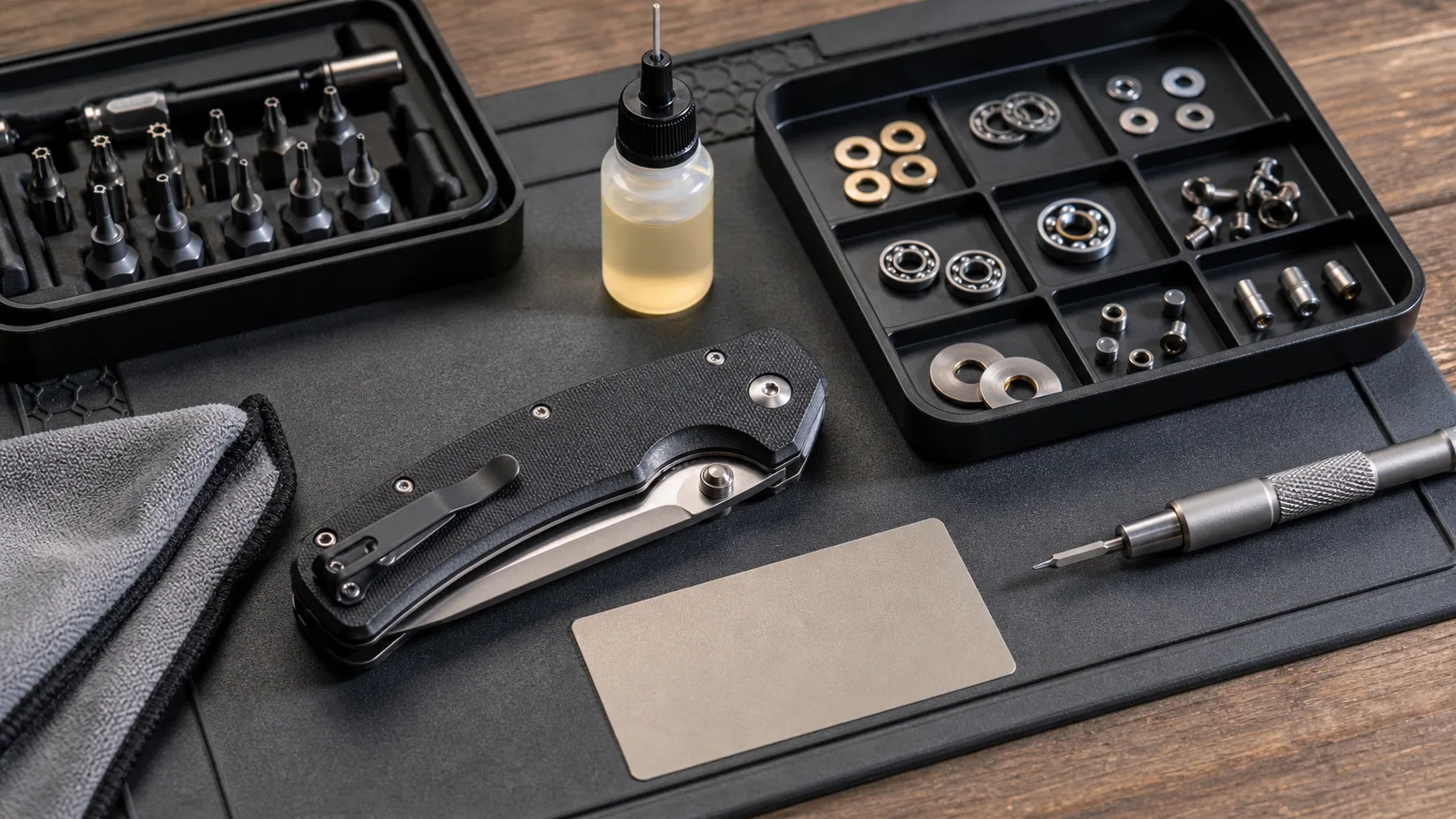
A useful knife pivot tool kit starts with an exact-fit driver, not a large collection of bits. T6, T8, and T10 Torx bits cover many folding-knife screws, but they are not a universal pivot specification. Seat the bit fully before applying pressure; if it rocks, slips, or does not reach the bottom of the recess, stop and verify the model.
Keep these tools together: a quality Torx bit driver, a second matching driver only for a two-sided or free-spinning pivot, a non-marring parts tray, low-tack tape or a marker for the starting position, a soft brush, a microfiber cloth, and a pinpoint applicator for a tiny amount of suitable lubricant. Threadlocker is not a default tool—use it only when the maker’s instructions call for it.
| Pivot specification | How models differ | What to verify first |
|---|---|---|
| Drive type and bit size | Torx is common, but the exact size and screw depth vary. | The bit seats fully with no wobble; never force the nearest size. |
| Captive or free-spinning pivot | A captive pivot resists turning from the opposite side; a free-spinning pivot may need two drivers. | Whether the opposite side has a drive recess and turns with the screw. |
| Washers or bearings | The support parts change cleaning needs and how sensitive the action is to tiny tension changes. | The maker’s parts diagram or the confirmed construction for that exact model. |
| Threadlocker and warranty | Some makers secure the pivot or restrict owner adjustment. | Current care instructions and warranty terms before breaking the original setting. |
What a careful adjustment looks like
If cleaning and light lubrication do not solve the issue, use only a bit that fits the pivot screw perfectly. Press straight down, make very small changes, and check blade centering, side-to-side play, and lock engagement after each change. Do not chase smoothness past the point where the blade is stable.
If a screw feels soft, the bit slips, or the pivot suddenly becomes loose, stop. Stripped screws and uncertain lockup are harder problems than stiff action.
When not to adjust
Do not adjust the pivot when the knife is new and warranty details are unclear, when the mechanism may be assisted or spring-driven, when the lock already feels unsafe, or when you cannot keep track of small parts. Do not disassemble a knife just because a video made a different model look easy.
The folding knife maintenance and disassembly guide covers when a deeper teardown might make sense. For most buyers, this article should end before full disassembly begins.
How the DISPATCH examples fit
The 3 inch drop point liner lock pocket knife is the one to inspect for compact lock feel and blade centering. Because compact knives give less handle room, a rough pivot can feel more obvious.
The 3.58 inch drop point G10 folding knife has more blade and handle surface for outdoor dust, cordage fibers, and camp packaging residue. Clean it before judging the pivot.
The 3.54 inch 8Cr13MoV G10 folding pocket knife is the general utility example. Keep the action clean, but do not turn ordinary maintenance into repeated screw changes.
Before the knife goes back in use
After cleaning or any tiny pivot change, check seven things: blade centering, side-to-side play, up-and-down play, lock engagement, closing control, excess lubricant, and local rules for where the knife will be used. If one check fails, the knife is not ready.
FAQ
Should I loosen the pivot if a knife feels stiff?
Not first. Clean lint and grit, dry the pivot area, and use minimal lubricant before touching the screw.
Are bearings better than washers?
They feel different. Bearings can feel smoother, while washers can feel more controlled and easier to keep clean. The better choice depends on the task and maintenance habits.
How much lubricant should I use?
Use a tiny amount, work the blade slowly, then wipe away excess. Too much lubricant attracts dust.
When should I stop adjusting?
Stop if the blade develops play, the lock feels inconsistent, the blade rubs the handle, or the screw/bit fit feels wrong.
Sources and verification
These external references support product identity, mechanisms, maintenance, sharpening, safety, or law-checking. Retail listings and local rules can change, so verify current details before acting.
Practical guides for choosing and caring for folding knives
Start with direct buying guides, material explainers, maintenance notes, and safety limits before choosing a folding knife.
Folding knife maintenance and disassembly guide
When to clean, oil, inspect, or skip disassembly on a folding pocket knife used for ordinary utility tasks.
How to close a pocket knife with no button (by lock type)
How to close a pocket knife by lock type, including liner locks, frame locks, back locks, button locks, and folders with no button.
How to clean and sharpen a pocket knife
Clean, dry, lubricate, and restore a practical pocket-knife working edge after packages, cardboard, cordage, and camp chores.
DISPATCH Amazon starter shortlist
Use these first picks to compare blade size, handle texture, lock style, and everyday utility tasks before checking final product details on Amazon.