Buying guide
Pocket knife sharpener buying guide
Choose the least aggressive pocket knife sharpener that restores your edge, with fit and stop checks for stones, guided systems, field tools, and strops.
As an Amazon Associate I earn from qualifying purchases.
Research basis: maintained product records and referenced background material. This page does not claim hands-on testing unless it documents that work explicitly. Editorial method.
Quick answer
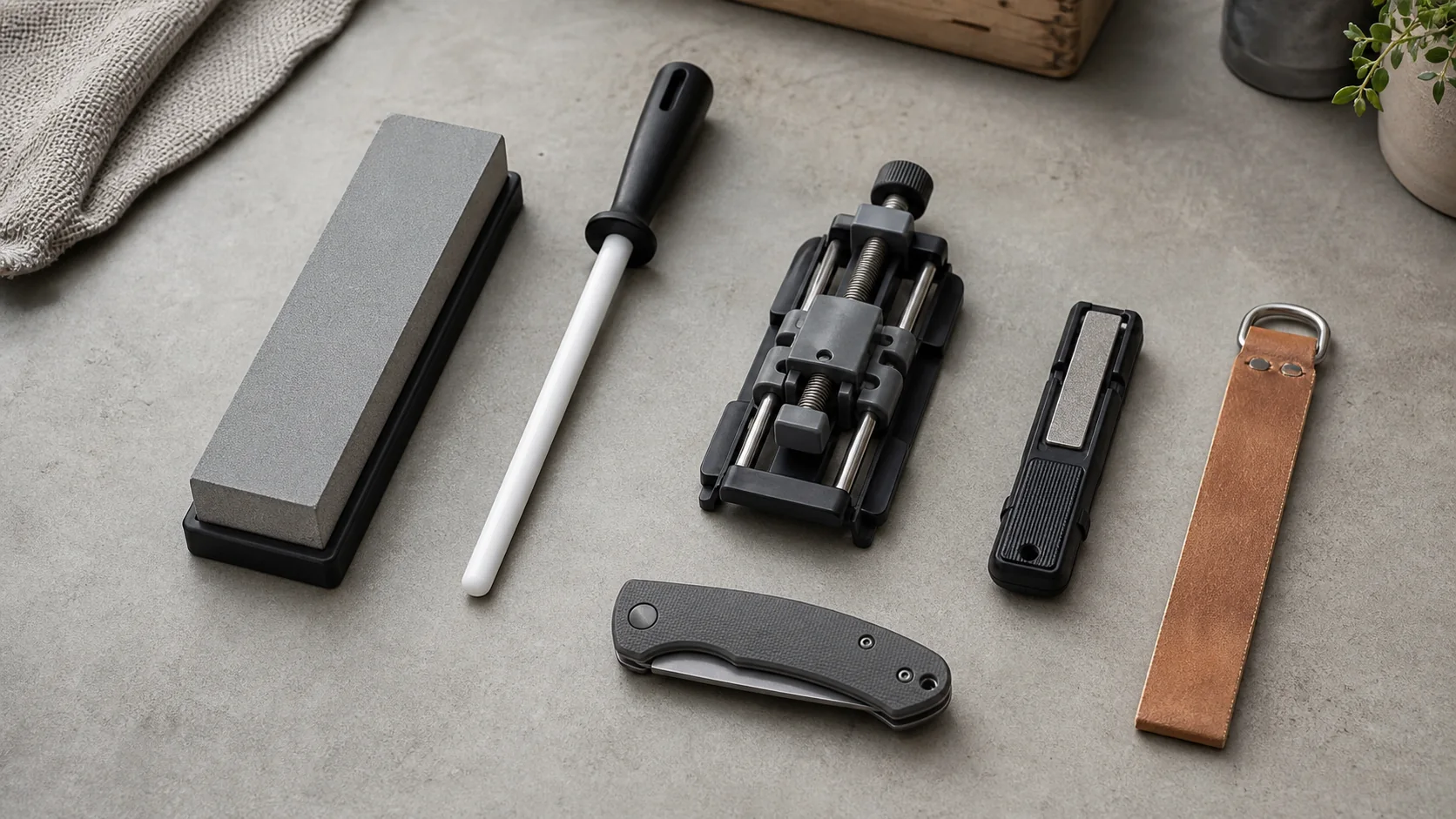
Inspect the edge before choosing a pocket knife sharpener. A nearly sharp plain edge needs a light touch-up; chips, rolls, or a worn bevel need a repair stage that removes more steel. Then choose how you want to control the angle. A fine bench stone is flexible but takes practice. A guided clamp is easier to repeat only when it fits the blade and the abrasives you intend to use.
A ceramic rod or leather strop can maintain an edge that is already close to sharp. A compact field tool gives up working area for portability. For ordinary folders used on tape, cardboard, cordage, and camp packaging, begin with the least aggressive tool that restores a clean cut.
| Sharpener type | Best fit | Main advantage | Skip or pause when |
|---|---|---|---|
| Fine bench stone | Users who want broad compatibility and can practice freehand. | Direct control over pressure and contact. | You cannot yet hold a steady angle or the stone has no clear use instructions. |
| Ceramic rod | Frequent light maintenance. | Quick refinement of an edge that is still in good shape. | The edge is chipped, heavily rolled, or completely dull. |
| Guided clamp system | Buyers who value repeatable angle setup. | Controlled angle and planned abrasive progression. | The clamp flexes, the blade will not seat securely, or replacement abrasives are unclear. |
| Compact field sharpener | Pack or camp-kit touch-ups. | Several maintenance stages in a small tool. | You need major repair, long working travel, or a very stable bench setup. |
| Pull-through tool | Occasional convenience on a matching plain edge. | Fast setup and easy storage. | The angle, abrasive, pressure, or supported edge shape is not explained. |
| Leather strop | Finishing a nearly sharp edge. | Refines the burr and cutting feel. | The bevel is dull or damaged and needs actual sharpening. |
Decide whether the edge needs a touch-up or repair
A tired edge that still has a clean bevel needs a different tool from a chipped, rolled, or heavily worn edge. For routine utility use, begin with the least aggressive option that can restore a clean cut.
Use a fine stone, ceramic, or strop for maintenance only when the edge is already close to working condition. Coarser abrasives remove steel faster and belong to repair or reprofiling work that requires more setup and skill. If the blade is damaged, the lock is inconsistent, or the edge geometry is unknown, professional service may be the better choice.
Angle choice belongs on the pocket knife sharpening angle guide. This page helps choose the tool; the angle page explains how to read the existing bevel and avoid unnecessary reshaping.
Choose freehand control or guided repeatability
Once you know the edge needs an abrasive, decide who will hold the angle. Your hand controls it on a bench stone. A guided system shifts that job to a clamp and rod, which makes blade fit and clearance more important.
A bench stone fits more blades but takes practice
A bench stone accepts compact and longer plain edges, and it lets you control where the abrasive contacts the bevel. Your hand must maintain the angle.
Check the stone’s abrasive material, grit, dimensions, flattening needs, and whether the maker calls for water, oil, or dry use. Those instructions are not interchangeable. A stone that is too small for a comfortable stroke or difficult to maintain will be used less often.
Choose a fine or moderate maintenance option before adding coarse repair grits. Stop adding abrasives once the set can produce a repeatable working edge for your pocket knife.
Check clamp fit before buying a guided system
A guided sharpener can make an angle easier to repeat, but the system still has to fit the knife. Inspect these points before buying:
- Blade fit: the clamp must hold the blade securely without contacting the edge.
- Stability: the clamp, base, rod, and abrasive holder should not flex or wobble during light use.
- Clearance: the abrasive needs room to reach the heel and curve without striking the clamp.
- Angle convention: confirm whether the marked number is per side or the complete included angle.
- Abrasive format: check stone length, plate backing, holder design, and supported thickness.
- Replacement supply: confirm that maintenance grits, repair grits, ceramics, and strops remain available.
As a stone wears, it can become uneven. A change in abrasive thickness can also alter the effective setup. Follow the system instructions for flattening, replacing, or compensating for worn pieces.
A large angle range does not correct a poor clamp fit. Start with the knife you own, then choose the system around its blade height, spine, shape, and expected maintenance.
Check the sharpener against the blade
The 3 inch drop point liner lock is a compact plain-edge example. With any clamp system, verify that a shorter blade still presents enough safe clamping area and clearance.
The 3.58 inch drop point G10 model has more edge length, so the sharpener needs comfortable travel from heel through the curve.
A continuous drop-point edge is easier to follow than an angular transition. Recurves, serrations, and tanto sections need abrasives and technique made for those shapes. Check the drop point or tanto guide before assuming one flat stone or fixed guide suits every edge.
Choose a field sharpener when storage space matters
A compact field sharpener makes sense when storage size matters and the edge is already serviceable. A useful design may combine a coarse stage, finer stage, ceramic, and strop, but the exact components and instructions vary.
The tradeoff is a shorter working surface and less room to stabilize the tool. Treat it as a maintenance kit for a pack, camp bin, or vehicle toolbox, not as automatic proof that major edge repair will be easy.
Very small scraping-style tools can remove material, but compactness does not remove the learning curve. If a tool has no angle guidance, safe grip, supported-edge description, or clear finishing step, skip it as a primary sharpener.
Treat pull-through tools as a conditional option
A pull-through sharpener can be convenient when its fixed geometry matches a plain edge and the maker provides clear instructions. It becomes a poor choice when the abrasive feels aggressive, the angle is unknown, or the blade has a shape the slots cannot follow.
Use light pressure and stop if the edge catches, chatters, or changes shape. Do not use convenience as a reason to keep removing steel. A fine stone or guided system gives more feedback when you are unsure.
Add a strop only after the edge is sharp
A leather strop is a finishing tool. It can refine a small burr and improve the feel of an edge that is already nearly sharp. It will not rebuild a damaged bevel or replace a stone when the knife is dull.
Check whether the strop is intended for bare use or a specific compound, keep it clean, and avoid rolling the edge with excessive pressure. Add it after you have a working sharpening method, not before.
Before you buy a pocket knife sharpener
- Inspect the edge and decide whether it needs maintenance or repair.
- Confirm the knife’s edge shape and the sharpener’s supported shapes.
- Choose freehand control, guided repeatability, or compact portability.
- Check abrasive type, grit progression, use instructions, and replacement supply.
- For guided tools, verify clamp fit, stability, clearance, and angle labeling.
- Keep the cleaning and basic sharpening sequence separate from the accessory decision.
Buy the smallest system that covers the work you will actually do. Leave a kit on the shelf if you cannot identify its stages or find compatible replacement abrasives.
FAQ
What pocket knife sharpener should a beginner buy?
Choose a fine bench stone if you want to learn freehand control, or a stable guided system if repeatability matters more. In either case, begin with light maintenance rather than coarse reshaping.
Is a compact field sharpener enough?
It can maintain an already serviceable utility edge. It is less suitable for major repair because the working surfaces and setup area are small.
Is a pull-through sharpener suitable for a pocket knife?
Only conditionally. Its angle, abrasive, and slots must match the edge, and the instructions should call for controlled use. Skip it when those details are unclear.
Does a strop sharpen a dull knife?
No. A strop finishes a nearly sharp edge; a dull or damaged bevel needs an abrasive that can restore it.
What should I check on a guided knife sharpener?
Check blade fit, clamp stability, abrasive clearance, per-side versus included-angle labeling, compatible stone formats, and replacement availability.
Sources and verification
These external references support product identity, mechanisms, maintenance, sharpening, safety, or law-checking. Retail listings and local rules can change, so verify current details before acting.
- Bilibili guided-sharpener compatibility video
- Bilibili compact-sharpener learning-curve video
- Work Sharp overview of knife-sharpening options
- Work Sharp Professional Precision Adjust guide
- Work Sharp Guided Field Sharpener guide
- DISPATCH official 3-inch drop-point product page
- DISPATCH official 3.54-inch 8Cr13MoV G10 product page
- DISPATCH official 3.58-inch drop-point product page
Practical guides for choosing and caring for folding knives
Start with direct buying guides, material explainers, maintenance notes, and safety limits before choosing a folding knife.
Pocket knife sharpening angle chart and guide
A practical pocket knife sharpening angle chart for choosing a durable working edge without grinding away steel or chasing a fragile bevel.
How to clean and sharpen a pocket knife
Clean, dry, lubricate, and restore a practical pocket-knife working edge after packages, cardboard, cordage, and camp chores.
8Cr13MoV steel guide for pocket knives
What 8Cr13MoV steel is, how it compares with D2, AUS-8, and S35VN, and why easy sharpening matters in utility pocket knives.
DISPATCH Amazon starter shortlist
Use these first picks to compare blade size, handle texture, lock style, and everyday utility tasks before checking final product details on Amazon.